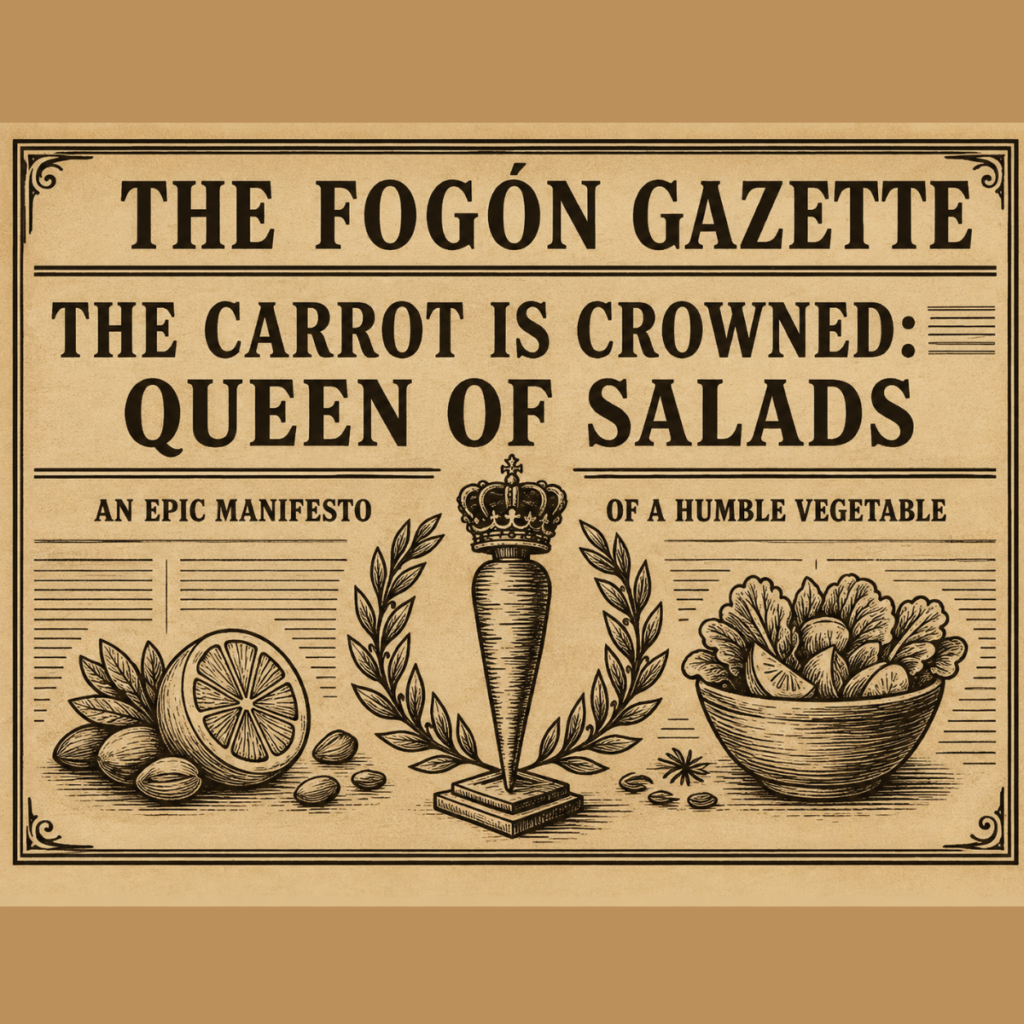
Find out why the humble carrot crowns itself and claims the throne: flavor, history, and kitchen science in an epic manifesto that will change your salads.
The Hearthside Gazette
The carrot demands to be recognized as the true queen of salads
An orange manifesto in twelve rounds and one crunchy epilogue. History, small science, and practical craft to give the humble root back the throne it deserves on the cold table.
In the yellowed archives of this publishing house there’s a note scribbled in pencil in the margin by a market reporter: “the carrot, brilliant commoner, governs without a crown.” Time has passed, delicate leaves have come into fashion along with sprouts named after novels and vinaigrettes that speak three languages, but the motto holds. Today we’re here to defend her, with a blazing orange argument to proclaim that among all the elements that make a salad worth celebrating, the carrot isn’t merely essential, she’s sovereign. As befits an ancient reign, her authority is exercised with discretion, patience, and a sweetness that doesn’t cloy but calls everyone to the table.
This piece is conceived as courtroom chronicle and popular song. We’ve called veteran gardeners to testify, along with neighborhood nutritionists, cooks who learned to grate with their left hand, and grocers who still smell like soil first thing in the morning. There is only one question: does the carrot deserve the scepter of salads? Listen to the market’s jury, follow the thread of the arguments, and if hunger gets the better of you, turn to the recipes we’ve attached and hand down your own ruling in your own kitchen.
Statement of grounds: the orange virtue
The carrot’s first virtue, we say without blushing, is her textural versatility. She can crunch in a stick, whisper in a slice, turn into a cloud when grated, become a petal under the peeler or a long thread under the spiralizer. Each shape changes the conversation on the plate: where there’s a knife, there’s an argument; where there’s a fine grater, a chorus appears. No other vegetable grants so many voices while asking nothing in return, apart from a decent wash and an attentive eye to avoid the oxidation that turns her bitter.
The second virtue is the color that organizes. On a table set for the queen of salads, orange doesn’t just cheer things up, it directs the eye. On short winter days it manufactures summer; in the heat it cools you with the memory of damp earth. Anyone who has ever added carrot to a tired salad knows it changes the mood of the plate the way a room changes when somebody opens the shutters.
The third virtue, less poetic and more domestic, is her memory in the fridge. She endures, she resists, she forgives. She lets herself be peeled without drama, keeps without fussing, and accepts being the last vegetable to leave the crisper. When the refrigerator looks like a station closed for repairs, there she is, employee of the month: punctual, cheap, and still looking good.
Identity file
- Name: Daucus carota subsp. sativus.
- Character: sweet, noble, slightly earthy, with a memory of the garden.
- Talents: color, texture, stability, friendship with acids and nuts.
- Weaknesses: overcooking, thick cuts for no reason, cloying vinaigrettes.
A brief history of a queen without a palace
Before she dressed in orange, the carrot wore purple, white, and yellow. The chroniclers of seeds tell us her modern splendor arrived with the Dutch varieties that fixed the color of sunrise. That genealogy explains her double nature, part farmhand and part diplomat. She grows without courtly demands, yet she talks to everyone. Where there are beans, she offers freshness; where bitter leaves rule, she cures with a discreet sweetness; if fruit shows up, she doesn’t compete, she accompanies.
The old markets bring evidence of her silent reign. In Sunday lunchboxes she travels grated with lemon; at after-school snack time she crunches in sticks that make recess forgivable; in vinaigrettes with cumin she makes you want to dance in the kitchen. Even the sternest grandmothers, jealous of the cucumber and devoted to the tomato, grant the carrot a seat at the head of the table when a lifeless salad needs saving.
Small science: why she rules the mouth
Our pen doesn’t tremble at talking chemistry in the middle of a market. The carrot holds natural sugars that never shout; her sweetness belongs to good after-dinner conversation, not to a county fair. When she meets acid (lemon, orange, sherry vinegar, or cider vinegar), she wakes up the friendly dissonance that holds up every memorable salad: a push and pull between tartness and sweetness. Add salt in the right measure and the balance appears as if by kitchen magic. This sensory orchestra, which would seem to require a conservatory degree, the carrot conducts without raising her voice.
In texture, her cell walls crunch with legitimacy. The sound isn’t breaking glass, it’s fine wood. While other vegetables go limp the moment they see a dressing, the carrot withstands the passage of time almost liturgically and makes salads that travel: lunchboxes, picnics, containers that take a nap. That’s what makes her queen in an age of hurry. She governs from inside the Tupperware.
Royal compatibilities
- Acids: lemon, lime, orange, sherry vinegar, rice vinegar, cider vinegar.
- Spices: cumin, coriander seed, paprika, cardamom, anise, harissa.
- Friendly fats: extra virgin olive oil, tahini, whole-milk yogurt, nuts.
- Fresh allies: green apple, celery, mint, parsley, cilantro, radish, cucumber.
Objections from the tomato’s defense (and their dismantling)
Let nobody accuse us of being unfair: we love the tomato, prince of summer. In the kingdom of salads, though, his seasonality makes him a vassal of August. The carrot reigns all year. Another pro-tomato argument holds that his juiciness rules. True enough, but sometimes a throne needs stability. The tomato turns a salad into soup if the dressing gets careless, while the carrot, firm as a column, ties the whole thing together and prevents shipwrecks. When the king is on vacation, the queen signs the decrees.
Some protest that “carrots are for stews.” That’s the verdict of people who have never tried a raw salad with citrus and freshly crushed cumin, or a coarse grating with green oil and pistachios. Nothing is more modern than championing the old: raw carrot solves the crunch-with-flavor dilemma better than almost anything, and she does it without asking for an oven, without demanding a surgical mandoline, with no equipment beyond the peeler you inherited.
The cut is the message: the queen’s grammar
If the language of a salad is the cut, the carrot speaks several dialects fluently. In sticks she offers a proud bite, perfect for thick vinaigrettes. In slices she turns polite, ideal for salads with salty cheese. In a coarse grating she calls for oil and lemon; in a fine grating she looks like orange snow, capable of dressing plates that didn’t know they needed dressing. The peeler yields ribbons that curl like parchment; a brunoise brings a rain of color over cold beans. All these grammars serve one purpose: giving the mouth a rhythm.
Vinaigrettes that do her justice
A queen deserves a court. The catalog below isn’t meant to be exhaustive, only a compass.
Classic lemon and olive oil
Two parts oil to one part lemon, salt that sings, and black pepper. Finish with chopped parsley. Foolproof for a coarse grating with green apple.
Sherry vinegar and cumin
Sherry vinegar, generous oil, toasted and crushed cumin, a hint of garlic. It turns into an Andalusian tavern with a handful of fried almonds.
Yogurt and tahini
Thick yogurt, tahini, lemon, salt, and a few drops of water to loosen it. Fresh mint. The carrot dances happily here with cooked chickpeas and raisins.
Orange and paprika
Orange juice, the smallest splash of cider vinegar, sweet paprika, and a shadow of smoked paprika if it suits. Pistachios and orange zest at the end.
Recipes for a coronation at home
The “Manifesto” salad (serves 4)
- Grate 4 good-sized carrots on the coarse side.
- Mix with 1 green apple in fine julienne and 2 celery stalks.
- Dress with lemon, olive oil, salt, pepper, and freshly crushed cumin.
- Crown with parsley, pistachios, and a drizzle of citrus honey.
Carrot, citrus, and aged cheese
- Carrot ribbons made with a peeler.
- Orange supremes, crushed green olives.
- Sherry and paprika vinaigrette; shavings of aged cheese.
Orange tabbouleh
- Soaked bulgur, plenty of carrot in brunoise, cucumber, and mint.
- Lemon, olive oil, salt; pomegranate seeds if they’re in season.
Chickpeas with tahini and carrot
- Cooked chickpeas, finely grated carrot, raisins, toasted pine nuts.
- Yogurt, tahini, lemon, and garlic sauce; fresh cilantro on top.
The nutritional defense, without boring anyone
A crown can’t be held up by poetry alone. The carrot is a reserve of carotenoids, long words the body puts to work in eyesight and immune function. We won’t insist on the vitamin catechism, though. It’s enough to know that the noble fat in olive oil helps those pigments ride in a carriage, which is exactly the wisdom of the grandmothers who never served a carrot without its drizzle of oil.
Another merit is her natural sweetness, which lets you cut back on added sugar in vinaigrettes. In salads with fruit, the carrot keeps the whole thing from turning into dessert; in salads with pickles, she softens the blow without betraying anyone. She’s a diplomat with backbone: she listens, she mediates, she decides.
The queen and her supporting cast
If you mixed her with everything, the carrot would be an absolute and boring queen. Better to choose discreet courtiers who make her shine. Cucumber brings water and coolness; green apple, a playful tartness; celery, the perfume of a riverbank; radish, the spice of good gossip; aged cheese, a crowning saltiness; nuts, crunchy nobility. Among herbs, mint and parsley are effective ministers, while dill, when it turns up, lends her an elegant mustache.
With cold beans, the queen signs firm alliances. Chickpeas and lentils find in her sweet crunch a partner that doesn’t fall apart, and the whole dish gains weight without losing the lightness we ask of a salad. With cooked grains, whether bulgur, couscous, or farro, she governs the texture and keeps the peace between bites.
Scenes from the market: testimony
“At my stand, when the heat shows up, people ask for lettuce; when a rush shows up, they ask for carrots,” says Concha, a greengrocer with a baker’s hands. “They take them for everything. Half of them don’t even ask the price.”
“I grate mine by hand because the sound of the grater puts me in the moment,” confesses Aurelio, a happy retiree. “It reminds me of my mother giving a Sunday salad its flavor without spending a dime.”
“On office lunch menus, the carrot is the seatbelt,” rules a dietitian who steers clear of trends. “The day eats you alive and she keeps your mood intact.”
Common mistakes (and their antidotes)
- Grating too far ahead. Antidote: lemon right away and into the fridge; better still, use the peeler, since ribbons hold up.
- Dressing without salt. Antidote: salt wakes up the sweetness. Without it, the queen yawns.
- Vinaigrettes that are too sweet. Antidote: trust her natural sugar. Anything more just cloys.
- Uneven cuts. Antidote: pick a cutting language and stick to it: sticks, slices, or grated, not all at once.
- Forgetting the fat. Antidote: good oil makes the color visible and carries the crown to the palate.
Seasonal whims: dressing the crown
In spring, the young carrot is a poem made of water, crunching like a freshly washed morning. She asks for mint, lemon, and a pinch of salt. In summer she keeps the tomato company without competing; in fall she looks for nuts and rounder vinegars; in winter she allies herself with sharp citrus and warming spices. This calendar doesn’t limit her, it makes her a queen of four seasons, able to show up in a shawl or a scarf, always with bearing.
Express coronations (ideas in 30 seconds)
- Ribbons + yogurt + mint: instant coolness for spicy dishes.
- Grated + lemon + cumin: universal companion to cold cuts.
- Sticks + tahini + sesame: a snack with dignity that needs no bread.
- Slices + orange + green olive: a Sunday appetizer with character.
International diplomacy of the color orange
In Morocco, carrot salad with cumin and lemon is practically a greeting. At the Ashkenazi table she shows up as tzimmes when she turns sweet and warm. In the Levant, tahini adopts her. In France, carottes râpées sign weekly agreements with the baguette. In our own homes, absent any treaties, she signs Sunday pacts. This presence across borders offers a lesson: whatever travels, reigns. The carrot speaks languages and understands schedules.
The queen before the child’s palate
If there’s a tough jury out there, it’s children. The carrot arrives with an advantage: her natural sweetness and her color rent out goodwill on arrival. Sticks turn into games; ribbons, into snack-time snakes; a fine grating, into confetti for sandwiches. A bowl of salted yogurt or a light mayonnaise will be enough for the junior court to sign non-aggression treaties with vegetables. The queen conquers without speeches.
Household economics of the throne
Greatness is also measured by price. The household carrot is cheap honestly, not through some trick. Buy her well by the bunch (the tops, if she has them, should look alive) and store her in a perforated bag. If there are tops, use them as an herb: a humble pesto with almonds, oil, and lemon. That way the queen governs without waste, a virtue this newsroom celebrates with fireworks of cumin.
The liturgy of prep: from the board to the bowl
Wash, peel if needed (often a good scrub brush is plenty), decide on the cutting language, dry so the dressing can embrace, salt with attention, measured acidity, noble oil, fresh herbs. The sequence may look trivial, but the whole protocol of the throne lives in that list. Whoever respects it will be named steward of the salad bowl; whoever ignores it will blame the messenger.
Popular demonstration: the complete salad
If this defense is going to end in an ovation, we need a salad that silences the room. We propose it below and request a large spoon so you can toss it without shyness.
The Coronation (main salad for 4)
- Grate 5 good-sized carrots on the coarse side. Add 1 peeled cucumber in half-moons and 1 green apple in thin strips.
- Add 1/2 cup cooked and cooled lentils, 1/2 cup toasted pistachios, and a handful of raisins.
- Vinaigrette: 6 tablespoons olive oil, 2 tablespoons lemon juice, 1 tablespoon sherry vinegar, 1 teaspoon toasted and crushed cumin, salt, and pepper.
- Herbs: plenty of mint and a little parsley. Toss with enthusiasm and let it rest 5 minutes.
- Finish: paper-thin shavings of aged cheese and orange zest. Ovation.
The myth that “everything tastes like carrot”
People sometimes claim her character colonizes the plate. Experience says otherwise: with fine cuts and a lively dressing, the queen doesn’t impose, she structures. She holds things up like a spine, lets the others shine (radish, cucumber, herbs, nuts), and keeps one last ace up her sleeve: she lets herself be marinated without letting herself be tamed. Trials in this newsroom with lime and ginger confirm it. At half an hour, the perfume is elegant rather than invasive; at two hours, the whole bowl seems to have come back from a spa.
Chronicle of a blind tasting
We convened six professional palates: a grocer, a photographer, a grandmother, a student, a cook, and a gardener. Three salads in competition: one of leaves only, one of tomato and cucumber, and the third, the Coronation. The verdict arrived with laughter. The third won by consensus and by hunger. The reasons: texture that holds, a dressing that converses, sweetness that doesn’t get in the way, power without fatigue. The grocer asked for seconds; the photographer went looking for better light and found color; the grandmother said, “this one has room for a Sunday.”
The queen served hot (a brief act of disobedience)
We’re going off script for a minute. Though this manifesto celebrates the salad, it’s worth remembering that carrots roasted with cumin and lemon, once cooled, become first-class citizens in warm salads. Their wrinkled skin brings caramel; their center, moisture; their perfume, the memory of an oven. Tossed afterward with arugula and tender wheat berries, the salad becomes seasonal without asking for a coat.
Manual for very busy days
- Sunday: wash and prep 8 carrots; store in a container lined with paper towel.
- Monday: coarse grating + lemon + parsley; into the lunchbox.
- Wednesday: ribbons + yogurt + mint + chickpeas.
- Friday: slices + orange + olives + aged cheese.
Poetics of the grater
Certain sounds define a house: the coffee maker first thing, water falling on hot dishes, the soft knock of the mortar. In this newsroom we’d add another: the whisper of the grater against a carrot. That sound gathers people and calms them. The children come closer, the grown-ups remember, the cat watches with dignity. The salad begins before the bowl does. It begins when the color appears in filaments and the kitchen smells briefly of open country.
The verdict
We have heard from market and kitchen, from science and memory. The ruling is clear: the carrot deserves the crown of salads for her ability to organize the plate, hold up the texture, build bridges between tartness and sweetness, and show up cheerfully in any season. Anyone who thinks we’re exaggerating should grate one, squeeze half a lemon over it, add oil and salt, and toss it with a green apple and a handful of pistachios. Then come argue with us, mouth full and happy.
— The Hearthside Gazette newsroom
An edition in ink and virtual paper. No carrot was forced to wear a crown during this report; she accepted it by popular acclaim.
Don’t miss the latest from our Gazette!