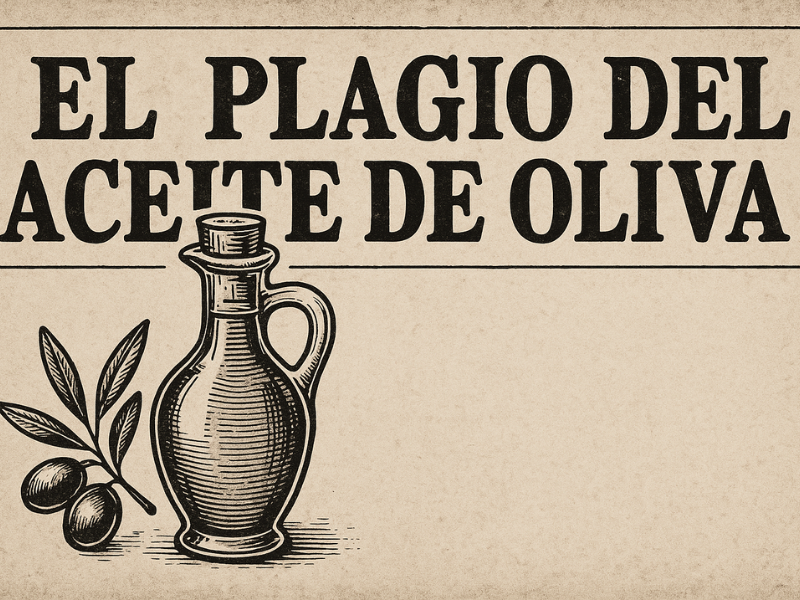
From Jaén, olive oil files a claim of international plagiarism and asserts its own authenticity: flavor, origin, and liquid truth in a manifesto with no equal.
A dispatch in twelve rounds and one green manifesto. A journey through century-old groves, the labor of the mill, the science of bitterness and pungency, and the case file of a complaint that has palates and labels in an uproar. Our subject speaks: olive juice, with a mountain accent and a memory made of stone.
The market telegraph brought a message this morning that smelled of crushed leaf: “I am filing for plagiarism.” The voice, low and bright, came from the south, carrying an echo of bells and the rustle of harvest poles. “Everyone wants to be me,” it went on, “but the real flavor is here.” The statement was signed by extra virgin olive oil itself, which asked to appear in capital letters and from a place with a protected designation tattooed across its gaze: Jaén, where the horizon is written out in trees that think in green.
We gathered the newsroom, put bread on the table, which is a sacred rule at this paper, and took notes while our subject poured out arguments as cleanly as it pours from a well-made cruet. What follows is the record of its complaint and, since we’re here anyway, an emotional and technical map of the thing we call “good oil,” with its glories, its myths, and its label wars.
Opening statement: Jaén takes the floor
Jaén doesn’t need a microphone. A winter afternoon, a cold sky, and one mill running are enough for everything to speak at once. The olives arrive like green marbles, in the hurry of something that knows freshness is an impatient clock. The tractors, formal about it, wait their turn with cooperative diplomacy. Inside, the mill. And in the settling tank, a thread that begins and doesn’t end: gold with flashes of lime, the bitterness of cut grass, and a finish that scratches the throat like someone remembering exactly where home is.
From this scene, the oil presents its case: “It doesn’t bother me that people want me,” it begins. “It saddens me that they imitate me without understanding my truth. My name gets used as a compliment nobody has earned. Designer bottles appear with graphene hearts on the label, whatever that is meant to mean, and promises of miracles that neither the field nor the mill ever swore to. They call things ‘virgin’ that smell tired, and they present themselves as ‘extra’ with blank paperwork. I am asking for respect. Whoever puts my surname on a bottle should have been through cold mornings, an early harvest, and noses that can tell green from rancid.”
Elements of the complaint
- Use of noble names on blends with no trace of real fruitiness.
- Confusing labels that promise origin without naming a grove or a harvest year.
- Imitation terminology (“olive flavor,” “olive style”) on products that are not juice.
- Contempt for freshness: oils that reach the table late, like reporting without a source.
A brief history of liquid gold, without the incense
The word “liquidambar” was coined by a poet. “Liquid gold” was coined by a merchant with a good ear. We’ll skip the carnival metaphors and say plainly that olive oil is squeezed fruit. It was that in Roman amphorae that crossed the sea, in buried clay jars, and in greenish glass jugs that smelled like Sunday. It is that today in steel tanks and dark bottles. Every era adds science to the ritual, and the miracle is identical: a healthy olive, milled immediately, malaxed at an honest temperature, settled without impatience, and kept in the dark. Jaén knows this, which is why it talks the way it talks.
“I am not perfume. I am food. But there are perfumes that give me away: tomato vine, grass, green almond, leaf, fig tree. When you can’t find them, be suspicious.” — Extra virgin olive oil, principal witness.
Round one: fruitiness and memory
Real oil has a nose. It opens it up and takes you to the grove even if you’re standing in a tiny kitchen with tile that reminds you of the seventies. It smells like what it was: fruit. Some oils, from an early harvest, throw notes that catch at the back of the throat and give bread a jolt of character. Others, riper, gather honey and softness. The oil’s complaint points at the copies. “They make me up with aromas that aren’t mine and they dim me with filtering that leaves the mouth with no story in it. Fruitiness isn’t perfume added afterward. It’s the biography of the tree.”
For anyone hunting for signals, fruitiness announces itself through the images it triggers: wet leaf, green banana, artichoke, tomato vine, even a note of hay. If the nose says nothing, or says “warehouse,” that’s a bad sign. If the mouth gets a flat impression and the finish doesn’t bite, the oil has fallen asleep or never woke up at all.
Round two: bitter, pungent, sweet, the trinity
The mouth doesn’t lie. Bitterness comes from polyphenols and from the young age of the fruit. Pungency comes from oleocanthal, a name that sounds like the title of a novel and is in fact the muscle that rasps elegantly at your throat. Sweetness, not the sugar kind but the balance kind, settles the extremes. Legitimate oil plays all three like a guitarist who knows the instrument. The imitations try too hard to please: they offer a boring sweetness with no drive and no edge. “Oil that doesn’t argue,” Jaén warns, “doesn’t converse.”
How to taste at home (short protocol)
- Pour an inch of oil into a small dark glass.
- Warm it with one hand and cover it with the other for 30 seconds.
- Inhale and remember: tomato vine? grass? almond? fig?
- Taste in a sip. Look for bitterness on the tongue and pungency in the throat.
- If the nose says nothing or the finish sits heavy, change bottles and change stores.
Round three: the hour of the harvest
Oil demands an early start. The green olive, the one that was promising autumn, holds treasure that turns to smoke if you wait too long. An early harvest is a wager: less yield, more character. The cooperatives know it and schedule shifts like a symphony orchestra. “My plagiarists,” the oil insists, “mistake me for a shadow. They arrive late, they warm up the malaxer, and they carry off whatever’s left of the summer.”
Don’t let marketing language fool you either. “First cold press” is a relic that survives today as decoration. What counts is the malaxation temperature and how much time passes between the tree and the mill. When it all happens on schedule, the jug sings.
Round four: varieties in dispute, a sentimental census
There is no such thing as olive oil. There’s a forest of personalities. Picual, the great lady of Jaén, shows off muscle, greenness, olive leaf, tomato, and a finish that combs the throat on its way down. Hojiblanca looks south and talks about almond and herbs when you work it finely. Arbequina, more diplomatic, offers itself round and agreeable, and treated well it shines like a Sunday breakfast. Cornicabra, the tough Castilian, brings back fig trees. The copies try to resemble all of them and end up resembling none.
A minimal pairing map
- Picual → tomato, bread, and anchovy; red meat; winter gazpachos.
- Hojiblanca → white fish, citrus salads, mayonnaise with a spine.
- Arbequina → baking, gentle soups, dressings for children and skeptics.
- Cornicabra → slow roasts, aged cheeses, grilled vegetables.
Round five: the bottle tells the story
Light is a friendly enemy. It warms, it oxidizes, it gossips to the passing months. Use a dark bottle or a tin, keep it in a cool cupboard, and look for a label that remembers its harvest year. If a bottle shows off its design and forgets the vintage, be suspicious. “My copies,” the oil says drily, “dress for the gala and forget their ID.”
We’ll add a domestic truth: the best oil is the oil you actually use. Buying five-liter jugs with no plan is writing a novel and leaving it out in the sun. Better to buy bottles you’ll finish before the memory fades. A kitchen, like a grove, runs on rhythm.
Round six: fraud, that long shadow
Every so often the markets erupt into paper battles: reports, seizures, laboratories with magnifying glasses. The oil’s complaint doesn’t point fingers. It asks for education. “Don’t protect me with bars,” it murmurs. “Teach people to taste. A public that recognizes bitterness doesn’t get fooled by counterfeit sweetness.”
The defense the old hands in the countryside propose is clear: cooperatives open to visitors, fairs with dark glasses and neutral bread, and stores staffed by people who can tell you where each lot came from. Fraud shrinks as the collective palate rises.
Round seven: small science for the countertop
Smoke point is not a panic signal. A well-made extra virgin handles daily cooking and hands you flavor other oils can only look at from a distance. A sofrito made with picual glows without scorching. A short fry moves along happily. Mayonnaise gains an inheritance. What oil doesn’t appreciate is the same frying bath repeated forever. Nobody asks a symphony to play unchanged for weeks. The plagiarists, once again, oversell virtues they don’t have, promising economic miracles when the actual miracle is the taste.
Quick manual of good use
- Raw: chilled soups, toast, grilled vegetables, fresh cheese.
- Medium heat: sofritos, stews, sautés. Finish with a raw thread on top.
- Short frying: steady temperature, clean oil, rest and filter afterward.
- Preserving: fish in oil, dried tomatoes, cheese in sterilized jars.
Round eight: the test kitchen, recipes with a verdict
Bread, oil, and truth (to start)
- Your favorite bread, ideally with a living crumb. Your young extra virgin. Flaky salt.
- Pour the oil onto a plate, dip without fear, and talk about what you smell.
Crushed tomato with picual
- Good tomatoes, grated. Minimal garlic. Salt. A generous pour of oil.
- Bread to the rescue. Life suddenly organizes itself.
Green hojiblanca mayonnaise
- Room-temperature egg, salt, lemon, and a slow thread of extra virgin.
- If it comes out too pungent, cut it with a milder oil, but don’t strip its personality out.
Arbequina cake
- Flour, moderate sugar, eggs, yogurt, and a good pour of arbequina.
- It comes out of the oven smelling like an afternoon in the yard.
Round nine: voices from the neighborhood
“My grandfather used to say that if it doesn’t bite, it isn’t telling you anything,” offers Carmen, a third-generation oil seller whose laugh sounds like a harvest.
“In my bar, the oil isn’t decoration. It’s the headline,” admits Paco, a barman who serves bread and a bottle alongside the beer as though it were noon mass.
“I work with extra virgin in desserts,” adds Laura, a pastry chef. “Arbequina is my fruity butter.”
Round ten: the language of the label
A label shouldn’t read like fantasy fiction. It should say, with the sobriety of a notary: variety, region, harvest year, acidity (which on its own tells you very little), best-before date, lot number. If it wants poetry, it can add that on another line. “My imitators,” the oil complains, “dress me in metaphor and forget to include the map.”
This newsroom’s advice: buy from shops that can say proper names out loud, taste, compare, and go back to whatever made you happy. Loyalty, in a kitchen, is a form of gratitude.
Round eleven: health and pleasure, the reasonable paragraph
We won’t play doctor, and we won’t stay quiet about the domestic evidence either: people who cook with good oil eat better. Breakfasts that start with bread, tomato, and extra virgin turn Mondays into days with a forecast. Stews that finish with a green thread on top get a second opening night. And in the fridge, a jar of carrots in oil with vinegar and herbs rescues dinners and starts conversations.
Round twelve: Jaén, the manifesto
We return to the source for the final signature. The oil, dropping its voice, asks three things of the world: respect for the tree, respect for time, and respect for the palate. “Whoever wants me,” it says, “should get up early with me. Harvest without doing damage, reach the mill without stopping for a nap, keep me in cool shade. And when you serve me, don’t hide me. I belong in front, not behind.”
Appendix: a minimal glossary for speaking properly
- Fruitiness: the set of aromas that recall fruit and open country. Never a warehouse.
- Polyphenols: the family that brings bitterness and guards freshness.
- Oleocanthal: the molecule behind the elegant catch at the back of the throat.
- Coupage: a blend of varieties. It can be an art or an alibi.
- Single varietal: one character only. It demands genuine personality.
- Milling: the passage from fruit to mill. The sooner the better.
Legal-poetic annex: a model complaint for consumers
Readers have asked us for something they could submit, should the need arise, when they feel cheated by a label promising what the glass doesn’t deliver. Here is our humble draft: “I, a palate with a memory, hereby declare that this product presents neither the fruitiness nor the pungency consistent with the designation ‘extra virgin.’ I request a review of the lot, a refund, and above all an explanation that doesn’t smell of fluorescent lighting.” Signed: the patience of the customer.
A kitchen tour: a green menu for four seasons
Spring — Dressed fava beans
Tender favas, spring onion, mint, and a pour of hojiblanca. Bread and conversation.
Summer — Gazpacho with an edge
Tomato, bread, garlic, vinegar, and picual without hesitation. Every glass, a reason.
Fall — Mushrooms in the pan
A quick sauté with garlic and parsley, finished raw with cornicabra.
Winter — Dressed oranges
Slices with black olives, salt, and arbequina. A breakfast that forgives.
Epilogue: instructions for a toast with bread
Anyone who has made it this far deserves a simple prize. Get bread. Open the bottle that made you smile last time. Pour it onto a plate, smell it, taste it, let your throat enjoy itself. Think about the tree, about the tired shoulder of the harvester, about the night shift at the mill, about the cooperative where decisions get signed over hot coffee, about the kitchen where people are laughing while the sofrito starts. Then, if you have the strength left, raise your glass, or your dish of oil, which counts the same today, and say it with us: “To the oil that is, and to the oil that wants to be. To a name used honestly. To Jaén, and to every olive grove that makes no noise and holds up the world.”
— The editors of The Hearthside Gazette
Printed in ink and virtual paper. No olive tree was felled for this report. Several loaves of bread were very happy.
Don’t miss everything happening in our very own Gazette.