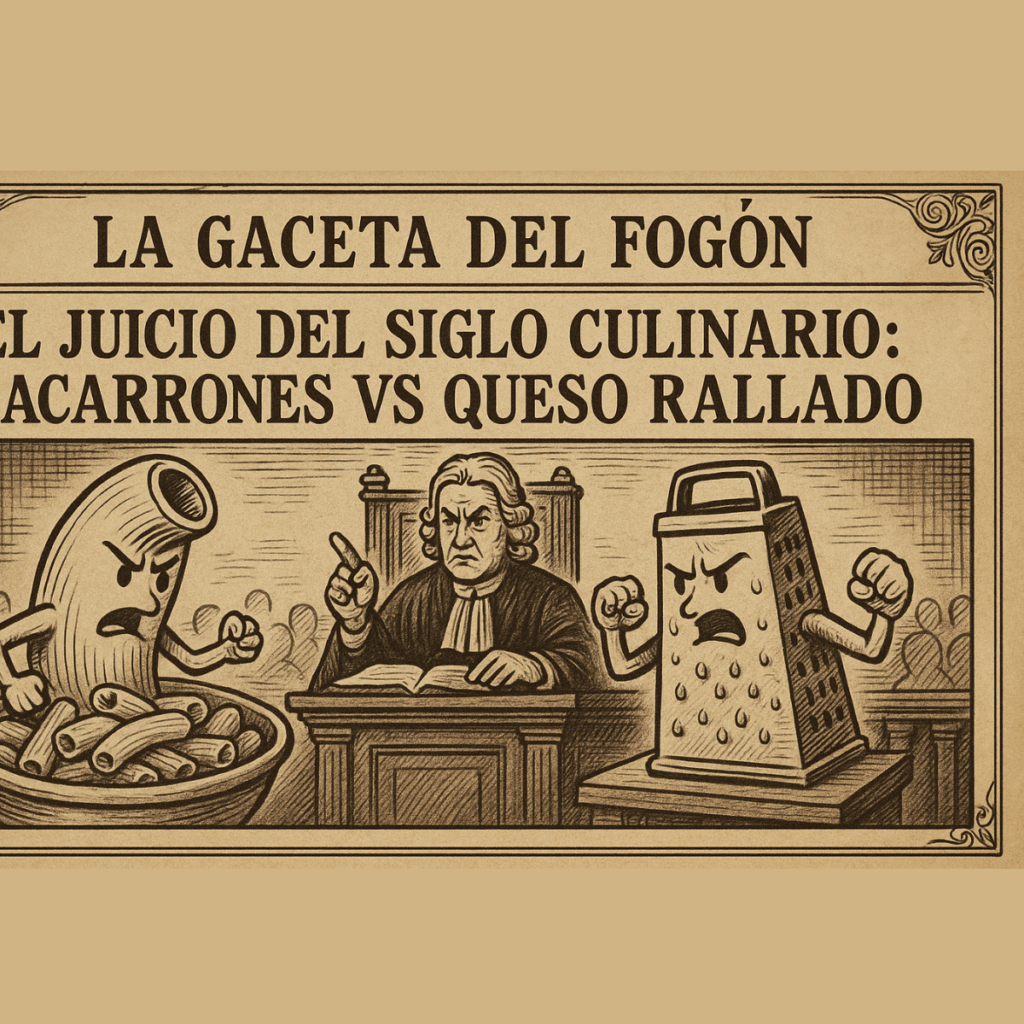
The macaroni sues the grated cheese and drags it before the tribunal of taste: a funny, delicious trial with a final verdict that will change the way you cook.
Courtroom reporting from the dinner table: short pasta demands equal treatment under the dairy rainfall, alleges biased coverage, and petitions for justice in the serving dish. Testimony, evidence, recipes, and a verdict that will rattle every spoon and grater in the house.
At eight o’clock sharp of the midday hour (official time of properly bound sauces), this newsroom opened proceedings in Cheese v. Macaroni. The complaint, filed by a delegation of al dente tubes striped with tomato, holds that grated cheese, which all of us until now took for a neutral condiment, “distributes its affection with open shamelessness,” clings to spaghetti like a signed exclusivity deal, and when the time comes to snow on macaroni “settles for passing clouds, with patches of sun and shadow that no one should have to tolerate.” What follows is a faithful transcript of a trial that is theatrical, certainly, and that touches nerves of both technique and hunger.
The patient reader will find an uncomfortable truth in these pages. Not all cheese grates alike, and not all pasta asks for the same snowfall. Justice in the serving dish, like democracy on your block, is exercised by serving everyone equally, without mounds melting on one side while the other side chews exile. To support the allegations, the culinary tribunal, made up of wooden spoons, dish towels, a precision scale, and this reporter, heard witnesses and examined evidence heavy with browned crust.
Opening record: charges and circumstances
Principal charges against grated cheese
- Biased coverage: it piles at the summit and avoids the valleys of the pasta.
- Selective adhesion: it embraces the long ones (spaghetti, tagliatelle) and snubs the short (macaroni, penne, rigatoni).
- Cronyism: it favors the hard cheeses of its own family and looks down on humbler blends.
- Delay tactics: it arrives late to the table, once the sauce can no longer take it in.
Counsel for the plaintiffs, a steaming plate of macaroni in an honest tomato sofrito, argued that “the cookbook photo gets an even rainfall, and at home the cloud passes over and drops hail in exactly one spot.” The expert witnesses in this matter, two veteran Parmigianos, one bad-tempered Pecorino, and a shy mozzarella, were called to testify on particle size, temperature, and humidity.
Profile of the accused: cheese as an institution
It should be noted that before this trial, grated cheese enjoyed prestige across every social line. From the corner diner to the trattoria of your dreams, its entrance provokes the same reaction: yes, please, and don’t be shy about it. The problem is not its presence. The problem is its conduct: how it falls, when, in what form, and in whose company. Like every institution, cheese needs bylaws.
File on the usual suspects
- Parmigiano Reggiano (12 to 24 months): crystalline, intense, melts with authority.
- Pecorino Romano: salty, sharp, superb with tomato, a bully in excess.
- Grana Padano: agreeable, good structure-to-flavor ratio when finely grated.
- Bagged blends: dry shreds with anti-caking agents. Capable of snowing, incapable of embracing.
- Melting cheeses: mozzarella, coarsely shredded provolone. They don’t crown, they blanket.
Round one: the grave charge of biased coverage
The macaroni contends that finely grated cheese, served in a mountain at the center of the plate, forms a snowcap that never reaches the rim. A spoon offers partial relief, but time, that enemy of emulsion, runs against you. The heat that should have helped it integrate dissipates the moment the conversation turns to the workday or the new price of olive oil.
Counsel for the cheese argued that “you cannot ask a snowfall to obey a zoning map,” and that responsibility for distribution lies with the hand doing the grating and with the plating strategy. He further alleged that macaroni, being tubular, hides pockets of air where cheese, by simple physics, hesitates.
Round two: selective adhesion, or the preference for length
The tribunal received comparative evidence. On spaghetti well tossed with sauce, fine shreds cling like a willing accomplice, every strand dragging a veil. On macaroni, by contrast, the morphological unit is the tube. Its outer surface is shorter and sharply curved, offering the cheese less road to travel, so the cheese goes hunting for crevices and ends up clumping.
The experts agreed that the texture of the macaroni matters. Bronze-die shapes, with generous ridges, hold both sauce and shreds far better. With identical cheese, the difference between smooth supermarket pasta and bronze-extruded pasta is as clear as the difference between a broken umbrella and a working one in the same storm.
Round three: the anti-caking conspiracy
An anonymous bag labeled “shredded cheese for pasta” was entered into evidence and, on examination, was found to contain starches and discreet quantities of cellulose. The macaroni denounced it as “pollen without a spring.” It falls, it whitens, it does not love. The defense shrugged: affordable, practical, never clumps. The jury, a panel of neighborhood palates, tasted it blind and recorded the sensation as well-mannered sawdust.
The golden rule of grating
- Buy the wedge whenever you can. Grate it the moment you need it.
- If you buy bagged, look for a coarse shred with nothing strange added.
- Match the grate to the job: fine to integrate, coarse to crown.
Round four: the hour of the cheese, that alibi
It was demonstrated that apparent favoritism is very often a scheduling error. Cheese that lands once the sauce has stopped singing becomes an independent layer. Cheese that arrives while pasta and sauce are still forming a marriage, that cloudy shining moment of emulsion, becomes a signatory to the certificate. The difference between justice and grievance, in this kitchen, fits inside thirty seconds on the clock.
Round five: plate topography and distribution tactics
We now summon the art of plating with intent. Wide platters allow rainfall with a trajectory. Deep bowls create a funnel, favor the center, and abandon the rim. A recommendation from the tribunal: serve macaroni in a wide platter, toss it in that platter with part of the cheese and not all of it, and bring a small bowl of extra shreds to the table so each diner can finish to taste. Call it participatory justice.
Testimony from the neighborhood
“If I don’t see cheese, I don’t start eating,” declares Marge, who runs the building, in a checked housecoat and holding a ladle she has clearly sharpened. “But if it just lands on top, I have to shovel it around, and by then it isn’t the same. The mood goes cold.”
“With macaroni, go coarse and blend in some pecorino,” suggests Pietro, a baker who knows his bronze dies and his ovens. “Fine grating is for spaghetti. Tubes need crumbs that stay put.”
“Favoritism is the fault of rushing,” rules a nutrition student on placement. “You turn off the burner, your phone rings, you get distracted for ten minutes, and by the time you come back there’s no embrace left to have.”
Evidence from the home laboratory
We built four identical scenarios of al dente macaroni with tomato and butter sauce, varying only the cheese and the procedure:
- Fine grate, cheese at the table: coverage in the center, orphaned rim.
- Fine grate, half in the pan, half at the table: notable integration, with a final snowfall for perfume.
- Coarse grate, all in the pan: partial melt, interesting texture, less photogenic but fair.
- Fifty-fifty pecorino and parmesan, method two: balance of salt and aroma. The jury applauds.
Verdict on the evidence
The macaroni declares itself satisfied when the cheese becomes part of the sauce in the pan, before serving, and then receives a final snowfall distributed by spoon from a modest height in wide circles. Favoritism drops to levels compatible with hunger.
Manual of justice: the anti-favoritism protocol
- Emulsify in the pan. Pull the pasta two minutes early, move it to the pan with the sauce, add cooking water, and toss until it shines.
- Cheese inside, cheese outside. Work part of it in over low heat. Finish at the table with the rest.
- Height and movement. Don’t pile. Draw circles as you scatter, like a patient painter.
- Texture is your ally. Look for ridged macaroni or bronze-extruded shapes.
- Strategic coarseness. Fine to melt in, coarse for a visible bite.
Case law cookbook: four binding rulings
Equal Protection Macaroni, in red (serves 4)
- Soften onion and garlic in olive oil, add crushed tomato, and let it go 20 minutes.
- Cook 12 oz of ridged macaroni. Reserve a cup of the water.
- Move the pasta to the pan with the sauce, add half a cup of water and 2 tablespoons of butter, and emulsify.
- Over low heat, work in about half a cup of finely grated Parmigiano. Serve and crown with a little more.
Pecorino and black pepper macaroni
- Toast coarsely ground pepper in the pan, then add a ladle of pasta water.
- Emulsify with butter and add the pasta.
- Off the heat, add finely grated pecorino a little at a time.
Baked macaroni, “no more favoritism”
- Toss the pasta with a light béchamel and tomato.
- Layer thin alternating sheets of cheese and breadcrumbs.
- Broil short and high: even snowfall and a democratic crunch.
Four-cheese macaroni, impartial edition
- Melt light cream in a pan with gorgonzola, taleggio, and provolone.
- Add the pasta, kill the heat, then add fine Parmigiano off the burner.
- Serve with the lightest possible coarse grate, from about a foot up.
A short chapter of small science: why it clumps
Grated cheese contains fat and protein. When it lands on a cold or dry surface, the fat doesn’t melt, and the particles grip each other through residual moisture and insufficient heat. Add anti-caking agents and you get loose shreds at the cost of a broken emulsion. Pasta water, rich in starch, acts as the mediator. It lets the fat in the cheese and the water phase come to an understanding. This is starch diplomacy, and starch arbitrates the whole process.
Particle size tells another story. A fine grate melts fast and disappears into the sauce. A coarse one delivers texture and delay. Used intelligently, the two together turn the dinner table into a functioning parliament: different voices that manage to understand each other.
For the defense: “there is no favoritism, only style”
Counsel for the cheese, an eight-sided box grater of considerable standing, delivered his closing argument. “My clients do not discriminate. They obey their own grating. The hard ones want to melt, the semi-cured ones want a scene, the fatty ones want to blanket. If the diner calls on them at the wrong moment, they have no choice but to gather where the heat is. The fault lies not with the snow but with the terrain.”
He asked further that the press stop demonizing bagged cheese. “In an office lunch container or an emergency, it does its job.” The tribunal noted the point and kept its suspicions. Justice may move quickly, but it should not impoverish the flavor.
On the role of butter and oil
Key evidence was introduced: one small cold pat of butter at the end of the emulsion. Result: shine, cohesion, and a noble runway for the shreds. In strictly oil-based versions, a few extra drops of good olive oil at the finish do much the same. The macaroni accepted this amendment with delight. Give us a landing strip, they said, and the cheese will land.
Macaroni morphology and its legal consequences
- Smooth macaroni: needs more cheese worked into the sauce. The final snowfall is largely symbolic.
- Penne rigate: ridges as case law. Handles the half-and-half method well.
- Rigatoni: wide tubes. Go coarse and toss hard.
- Cellentani or elbows: curves that trap. Watch for mounds forming in the bends.
The economics of justice: how much cheese is fair
Favoritism rises with excess. We observed that some cooks, eager to please, pour so much cheese that the sauce collapses under it. The prudent range for four people and 12 oz of pasta runs between 2 and 3 oz of hard cheese, split between what goes in and what goes on. Past 4 oz the process starts to look like eminent domain: the cheese takes the plate and the pasta applies for asylum.
The children’s dissenting opinion
The junior delegation submitted its testimony holding a short fork. “We want visible cheese.” The tribunal proposed a settlement: a coarse grate at the table, after the fine grate has already been worked into the pan. Both expectations were met, flavor within and spectacle without. Childhood entered its satisfaction into the record and asked to do it again, as Friday regulations require.
Common errors and their grounds for appeal
- Grating from a great height into a deep bowl. Remedy: wide platter, slow circles.
- Using damp cheese straight from the fridge. Remedy: let it sit out 10 to 15 minutes.
- Plating without emulsifying first. Remedy: pasta water and tossing until it shines.
- Over-salting with pecorino. Remedy: taste first. The sauce already salted the water.
- Forgetting the starch. Remedy: never pour all the water away. It’s currency.
Historical precedent
Market chronicles recall that in certain grandmothers’ houses the cheese arrived in a lidded sugar bowl. The hand served one small spoonful at a time, stirring patiently. Nobody spoke of favoritism, because the rainfall was fine and democratic. In trattorias of Roman memory, the waiter shaves the wheel over the platter, circling the table like the hand of a clock. Time and distribution in circles, which pacifies a dining room.
Closing argument for the macaroni
The macaroni, speaking in the voice of a tube on a Sunday, asked for three things: respect for their terrain, time for the emulsion, and judgment in the choice of cheese. “We aren’t asking for more than the others,” they declared. “We’re asking for the same.” They gave assurances that with justice served, children will start requesting macaroni again and food photographers will have a plate worth shooting without retouching.
Findings of the court
Having seen what it has seen and heard what it has heard, this tribunal finds it proven that the favoritism of grated cheese is an emergent phenomenon born of poor procedure and urban haste. It is hereby ordered that the diligent cook shall:
- Choose cheese with a personality and grate it at home whenever possible.
- Emulsify pasta and sauce before the rainfall.
- Distribute the cheese in two phases: integration and finish.
- Measure the quantities and take advantage of the terrain of ridged pasta.
Epilogue: the pact of the platter
A symbolic agreement was signed in the presence of spoons and dish towels. The cheese undertook to fall in circles rather than mounds. The macaroni undertook to reach the pan with the punctuality of proper al dente. The sauce undertook to keep its shine with the help of the starch. The pact was celebrated with a round of Equal Protection Macaroni and the laughter of a box grater. For once, the table looked like a parliament without shouting.
Service annex: an impartial weeknight menu
1) Bitter greens with lemon
It balances the parmesan coming later. Honest oil, salt, lemon. Nothing else.
2) Equal Protection Macaroni (base recipe)
As written above. Serve with good crusty bread for wiping the case law out of the pan.
3) Fresh fruit
To close the session with a clear head. Justice appreciates simplicity.
The reporter’s postscript
Those of us who write about food know that humor at the table is the best seasoning there is, and that lawsuits at the stove are excuses to sharpen our procedures. This trial, with all its exaggerations and its patent-leather solemnity, means only to remind us of the obvious. A plate of macaroni treated properly is a small piece of the world put in order. Cheese, far from being the guilty party, is a loyal ally the moment you give it the right stage.
So ends our record. If, after reading these lines, someone picks up a grater with fresh wisdom and draws wide circles over the platter, this newsroom will consider the sentence served. May your cheese fall fairly, may your macaroni arrive with an argument, and may the conversation, well beyond the plate, always find its point of emulsion.
— The editors of The Hearthside Gazette
Printed in ink and virtual paper. No grater was harmed. Several prejudices were.
Don’t miss the latest from The Hearthside Gazette.