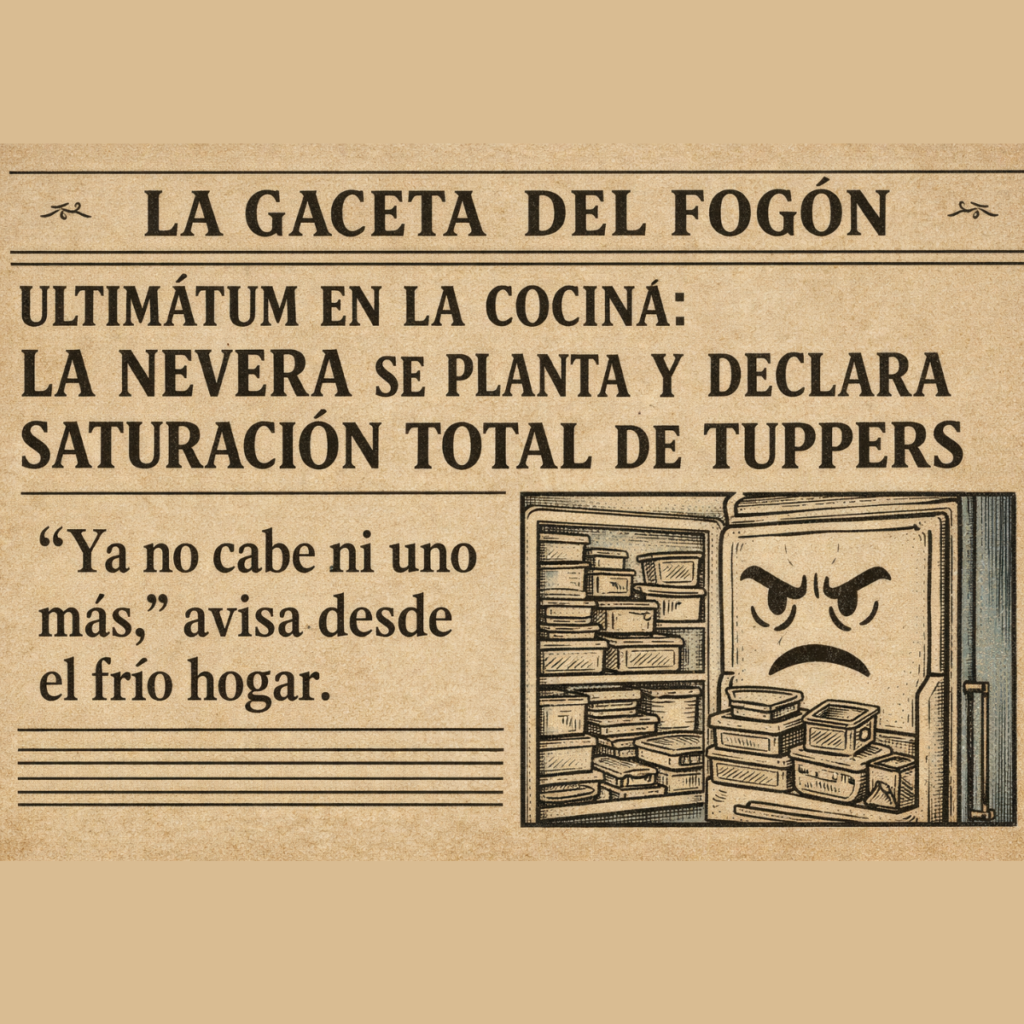
The refrigerator has had enough and announces it will take no more containers: a funny, revealing dispatch about order, leftovers, and household chaos.
Urgent communiqué from inside the fridge: a shelf strike, a drawer mutiny, and an ultimatum to the republic of stacked plastic. Filed in two columns, with an inventory, remedies, and a peace treaty to let the food breathe again.
Last night, around nine thirty, the hour when a house slows down and the kitchen is left alone with its secrets, the refrigerator cleared its throat. It wasn’t the motor, and it wasn’t the usual sigh of the thermostat. It was a deliberate throat-clearing, the kind a civil servant makes before reading out a municipal decree. When the door opened it let out a cold breath that smelled of onion, yogurt, and faint sadness, and from inside, lit like an interrogation room, came a sentence colder than the ice: “Be it known to the public that this refrigerator will accept no further containers.”
The family, or the house, which are sometimes the same thing, reacted the way people react to unwelcome truths. First laughter. Then negotiation. Then an attempt to wedge in one more container “just this once.” The refrigerator held firm. Not an inch of give. No “shove it up top, it’ll fit.” No “put it in the door.” That “no” was a seal. A “no” from a government office. A “no” with a manual attached.
This newsroom treats domestic conflict with the gravity it deserves, so we dispatched a correspondent to the scene, a stool in front of the appliance, and took notes. This announcement is no whim. It’s news of consequence. It affects the household budget, the weekly plan, your peace of mind on a Tuesday, and your constitutional right to see what in the world is behind the mountain of containers hiding the cheese.
Situation report: how we reached saturation
The tribunal’s first question is always the same. How did we get here? The answer, like most things in a kitchen, comes down to three words: intention, hurry, guilt.
Intention, because one day we promised to get organized. Cook Sunday for the whole week. Use up the broth. Freeze the sauce. Save the rice, just in case.
Hurry, because Monday night time folded up like a napkin and we put the rest away as it was, in the wrong-sized container with the lid half on.
Guilt, because throwing food out hurts, and because the refrigerator, that great institution of hope, lets us postpone decisions under the comfort of a white light.
Standard inventory of a fridge on the brink of mutiny
- Container A: lentils from last Thursday (fourth reincarnation).
- Container B: rice “that was left over.” No label, no country.
- Container C: tomato sauce, a portion for two, stored in a vessel built for six.
- Container D: a sad salad with watery cucumber and a lemon cut into two dry halves.
- Jar E: “pickled things.” Nobody remembers which.
- Bag F: greens that have looked into the abyss.
- Box G: cheese, hiding behind everything like a secret.
The fridge speaks: official statement
We requested a formal declaration. The refrigerator, normally a private appliance, agreed on the condition that we not leave the door open longer than necessary, “because then I get accused of waste.” Its words, as recorded by this reporter, were as follows:
In its statement, the fridge listed grievances: containers stacked without logic, vessels with no date on them, missing lids, jars with unidentifiable contents, and one particularly offensive abuse, putting hot food inside “because I’m running late.” It said, with cold severity, that this “creates condensation, confuses the smells, and demoralizes the yogurt.”
Round one: the container as ideology
A container isn’t an object. It’s an idea. It represents the promise that tomorrow we’ll be better people. That we’ll eat what we cooked instead of whatever we improvise. That waste will go down and time will stretch further. Which is exactly why it stings when the plan overflows and the container turns into an archive of failed intentions.
The fridge is denouncing container inflation the way an economist denounces a bubble: too many vessels for too little order. “They have occupied my shelves like an army with no chain of command,” it says. “And I, ladies and gentlemen, am not a battlefield.”
Round two: the top shelf declares itself a disaster zone
The top shelf, traditionally reserved for ready-to-eat food, had been seized by a stack of containers leaning at a dangerous angle. That’s where the dramas live: the container that spills when you pull out the one underneath, the jar that falls and shatters the peace, the lid that shoots off and vanishes under the crisper drawer like a fugitive.
Household experts agree that the top shelf is the parliament of the refrigerator. If there’s chaos up there, everything below becomes a failed state. The fridge, tired of propping up weak governments, announced an intervention.
Round three: the crisper drawer applies for asylum
In the course of the investigation we found a hidden tomato, a carrot bent into a question mark, and a bag of lettuce that had gone from green to philosophical. The drawer, which ought to be a garden, was a trench. The fridge took offense: “They hand me vegetables full of hope and turn them into penance.”
The root of the problem, in its view, is an excess of “anxiety provisioning.” We shop as though Monday were an apocalypse, and then the week runs us over. The drawer can’t defend itself if we fill it with promises and no schedule.
Round four: the science of cold air
There’s a technical reason for the ultimatum on top of the emotional one. Cold needs to circulate. When the shelves turn into Tetris, the air stops traveling. Hot zones and frozen zones appear, and food ages unevenly. Yogurt turns sour early. Soup cools halfway. Cheese sweats. Deli meat dries out. The fridge, proud of its trade, considers this an attack on its reputation: “They blame me for what their own disorder did.”
Signs your refrigerator is calling for help
- You open the door and find nothing, even though it’s full.
- The containers stack into towers with a political lean.
- There are sauces in giant vessels and stews in tiny ones.
- You find “something” and can’t remember what it is.
- The door won’t shut on the first try, or it clicks with resignation.
Round five: testimony from the household
“I hold onto things because I feel bad,” confesses the Microwave, who lives nearby and hears everything. “Then they bring them to me dried out and blame me for it.”
“I’ve been asking for labels for years,” says a Wooden Spoon, a veteran. “People believe memory is infinite. It isn’t. Not the fridge’s and not the human’s.”
“They put hot containers in me and fog up my insides,” adds the Freezer, who speaks less, and when he does, it chills. “Then they complain that I make ice. What do you want, applause?”
The great debate: containers, yes or no?
The tribunal’s answer has nuance in it. A container is a tool of civilization when used with method. It’s an enemy when used as a hiding place. The fridge doesn’t hate containers. It hates the absence of a system. That’s why the statement doesn’t say “banned.” It says “no more.” It’s a limit, not an exile.
Peace treaty: the five-zone system
To settle the conflict, we propose an international shelf accord, modeled on old treaties and on plain logic. Divide the refrigerator into five zones with clear rules:
The five zones (and their law)
- “Today and tomorrow” zone (top shelf): ready-to-eat food, small portions, no stacking.
- “Ingredients” zone (middle shelf): dairy, deli, eggs, cheese. Visibly organized.
- “Sauces and jars” zone (the door): sealed and labeled. Nothing fragile.
- “Vegetables” zone (crisper): dry, whole vegetables, no containers crushing them.
- “Rescue” zone (a marked corner): two containers maximum. One goes in, one comes out. Eaten or frozen.
The key is the rescue zone: an official place for the leftovers that might otherwise be lost. Fast rules apply there. Anything older than three days gets a decision. Transform it, freeze it, or say goodbye. No drama, but no hedging either.
The art of transforming leftovers without descending into sadness
The fridge will accept leftovers if you give them a future. Leftover lentils become soup with paprika and a pour of olive oil. Roast chicken becomes croquettes, or a salad with yogurt and lemon. Rice can come back as an omelet or as fried balls with cheese in the middle. The problem was never storing. The problem is not converting. The fridge, being pragmatic, proposes a mandatory second-life policy.
Fast second lives (a survival manual)
- Roasted vegetables → puréed soup with croutons.
- Stewed meat → ropa vieja with a fried egg.
- Plain rice → rice omelet with onion.
- Cooked pasta → frittata with cheese.
- Broth → fast soup with thin noodles.
The label: a container’s passport
Here the refrigerator turned strict. It said, word for word: “No vessel enters without a name and a date.” And it’s right. The label is the food’s passport. You don’t need a notary’s handwriting. A sticky note or a marker on the lid will do. “Lentils, Jan 2.” “Tomato sauce, Jan 3.” “Chicken, Jan 4.” Clarity prevents tragedies and cuts down on the number of edible mysteries.
The reader may object here that this is overkill. We answer with a real scene: opening a container without knowing what’s in it and sniffing it with suspicion is a defeat for modern civilization. Labeling is civilizing.
Round six: sizes, lids, and the chaos of things that don’t fit
The fridge also denounced what it called lid anarchism. A container with no lid takes up space like a debt with no contract. The lids, for their part, multiply like single socks. The solution is standardizing your formats. Few sizes, stackable, ideally rectangular, because geometry wants to live. Round ones are romantic, and they occupy territory without permission.
Round seven: the freezer as ally, not cemetery
Plenty of refrigerators collapse because the freezer gets used as a sealed castle: things go in without a map and never come out. To be useful, a freezer needs a minimum inventory. One rule: freeze in flat portions, with a date and a name on each. And once a week, hold a thaw day. Take one thing out and eat it. A freezer isn’t a museum. It’s a pantry with snow in it.
Round eight: household economics and shopping deliberately
The container problem doesn’t start on the counter. It starts at the store. We buy too much, out of fear of running short, out of sales, out of impulse. Then the fridge suffers. The remedy is a humble one: plan three substantial meals and leave room to improvise. There’s no such thing as a perfect grocery run, and there is such a thing as a reasonable one. The refrigerator appreciates it the way anyone appreciates quiet.
Round nine: the psychology of “just in case”
“Just in case” is the true occupant of the refrigerator. Just in case I want soup. Just in case I get home late. Just in case someone comes over. Just in case I start a diet. “Just in case” materializes as containers. Then real life arrives and the fridge becomes an archive of futures that never happened.
The answer isn’t to stop planning ahead. It’s to set a limit: one “just in case” at a time. Everything else gets cooked when it’s needed. A kitchen lives in the present, even if it keeps a memory.
The verdict: the refrigerator is right
Having examined the evidence and heard the witnesses, this paper declares that the refrigerator is within its rights. Its ultimatum isn’t tyranny. It’s hygiene. Demanding air, visibility, and method is demanding health. The fridge doesn’t want to run your life. It wants to be allowed to do its own job: to preserve, not to punish.
What it’s proposing, underneath it all, is a philosophy. Less accumulation, more rotation. Fewer vessels, more actual food. Less promise, more dinner.
Practical appendix: a 15-minute plan to unclog
Operation Free Shelves (real stopwatch)
- Minutes 1 to 3: pull out anything with no lid or no purpose. Decide fast.
- Minutes 4 to 6: group the containers by date. Oldest to the front.
- Minutes 7 to 9: pick two containers for the rescue zone and label them if they aren’t labeled.
- Minutes 10 to 12: wipe up spills and check the crisper drawer.
- Minutes 13 to 15: decide tonight’s rescue dinner, whatever needs eating first, and leave one shelf with air on it.
Epilogue: a letter of reconciliation
As we closed the report, the refrigerator asked for one last paragraph, almost as a postscript. “Don’t hate me,” it said. “I keep what you love. But I can’t love what doesn’t breathe.” Then it added, with a tenderness strange in a machine: “Give me space and I’ll give you peace back. Organize me and I’ll give you time back. Respect me and I’ll give you back food that still tastes like home.”
For the first time in weeks, the family saw the back of the shelf. They found the hidden cheese, the jar of capers that had been waiting years for its moment, and a half-decent lemon. The refrigerator, satisfied, made its usual sound, that breathing that used to seem like complaint and now sounded like calm.
The treaty was signed. Two containers maximum in rescue, labels mandatory, top shelf free of towers, vegetables treated with dignity. The refrigerator lifted its veto on one condition: “If anyone puts a hot pot in me again, I’m closing the borders.”
— The editors of The Hearthside Gazette
Printed in ink and virtual paper. No container was criminalized. Several were retired with honors.
Don’t miss the latest from our Gazette.